Rummy Rush - Classic Card Game
- 4.8
- Rating
- 1.00M
- Installs
- Free
- Price

 Analysis by App-foxy
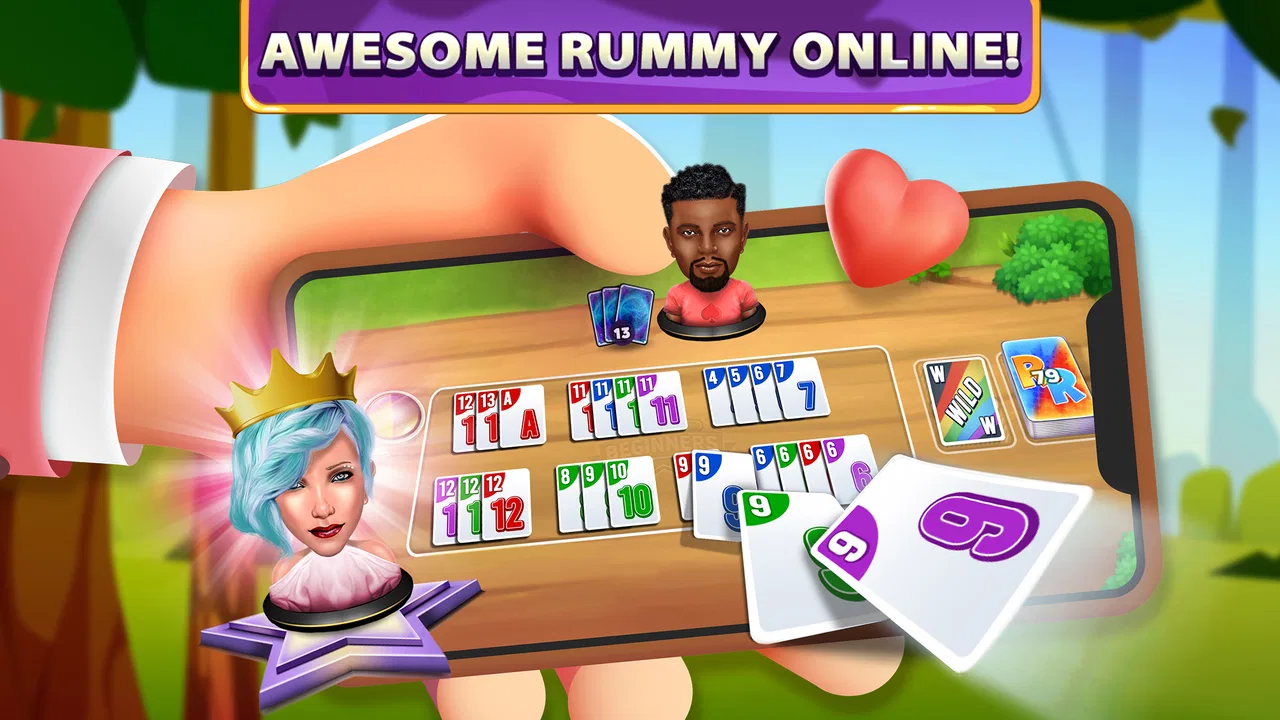
I picked up Rummy Rush expecting a quick card game and found something better suited to short, social sessions than to long, silent study. It brings the familiar rules of rummy into a live multiplayer format, so the appeal comes from making decisions while other people are waiting for their turn. That small amount of pressure changes the feel completely: a hand that seems simple on paper can become tense when I am deciding whether to hold a useful card, discard it, or risk helping the next player.
Developed by Beach Bum Ltd., this free card game is aimed at players who already enjoy rummy or want an accessible way to play it on a phone. It is rated for Everyone, runs on Android seven point zero or later, and the current version is 3.22.11. The broad audience makes sense because the basic idea is easy to recognize, but the live format still gives experienced players room to make sharper choices.
After spending time with it, my view is straightforward: this is a good choice when I want a social rummy match that gets moving quickly, but it is less convincing if I am looking for a quiet, completely offline card experience or a deep campaign with a carefully written progression story. The game’s strongest hook is the match itself. Its longer-term appeal depends on whether I enjoy repeating that loop and managing the pressure that comes with a free-to-play structure.
You May Also Like

 Blood Strike: 2.5 Anniversary
Blood Strike’s Loadouts Turn Every Drop Into a Tactical Gamble
A close look at Blood Strike’s custom loadouts: how fast access to signature weapons reshapes its battle royale rhythm, rewards preparation, and narrows the gap between fights.

 Pandora - Music & Podcasts
Pandora’s Music Is Easy to Start, but Harder to Recover
Pandora’s strength is its low-effort path from a seed to a station. Its weak spot is how much confidence it asks you to place in connection, setup, and quiet recovery.

 8 Ball Pool
 Is Built on Rivalries, Rematches, and Routine
A close look at the rivalries, rematches, shared routines, and unanswered safety questions that turn a quick pool match into a persistent mobile community.

 Samsung Music
’s Quiet Strength Is Playing What You Already Own
Its reach comes less from spectacle than from dependable access to a personal library. That simplicity is both the app’s strongest retention engine and its ceiling.

 AccuWeather: Weather Radar
AccuWeather Review: A Quick, Clear Forecast for Everyday Decisions
For everyday plans, the best forecast is the one you can understand quickly. AccuWeather makes rain timing, radar, and local conditions easy to act on, with a few trade-offs.

 Hill Climb Racing
Why Hill Climb Racing Still Turns Crashes Into One More Run
A tiny car, a bumpy hill and one more upgrade: Hill Climb Racing keeps resurfacing because its simple chaos makes every near-miss feel personal.
More From Our News Desk



How the first matches create a reason to keep playing
The early goal in Rummy Rush is refreshingly clear. I am not trying to learn a complicated collection system before I can enjoy the game; I am trying to form valid combinations, discard intelligently, and finish a hand in a better position than the other players. That clarity matters on a mobile screen. I can understand what I am working toward without stopping to decode a large menu of objectives.
For a newcomer, the first useful habit is to separate cards into possible sets and runs rather than treating every attractive card as equally valuable. A pair may look promising, but keeping it too long can block a more realistic sequence. I found that the game becomes more interesting once I stop chasing every possible combination and start judging which cards are actually likely to arrive before the hand moves on.
The live setting gives those early decisions more weight than a purely solo version against predictable computer opponents. Even when the rules are familiar, another player can change the rhythm by taking a card I wanted or discarding something that suddenly makes my hand dangerous to keep. That makes the first sessions feel like practice with consequences rather than a tutorial that exists only to delay the real game.
I also like that the central objective does not need much explanation to friends. If I wanted to introduce someone who has played physical rummy, this would be easier than suggesting a more elaborate digital card game with several currencies and layers of collection. The barrier is not the rules; it is becoming comfortable with the speed of live decisions and with the possibility that a sensible plan can collapse after one unlucky draw.
The small decisions that matter more than they first appear
One of my most useful adjustments was to watch the discard flow instead of focusing only on my own cards. A discard is information. If someone repeatedly avoids a suit or takes a card from the visible pile, that can suggest what they are building. I do not treat those clues as certainty, but they help me decide whether a tempting discard is harmless or likely to complete another player’s hand.
Another practical tip is to set a point at which I abandon a weak plan. Holding several disconnected cards because one of them might become useful feels hopeful, but it also leaves less room to adapt. In a quick multiplayer match, flexibility is often more valuable than a beautiful combination that still needs several specific draws. This is the kind of lesson that gives the game more staying power than the simple store summary suggests.
The best everyday use case is a short break when I want interaction without committing to a large online game. I can imagine playing a match while waiting for an appointment, then stopping rather than feeling obligated to complete a long chapter or mission. It also works for friends who want a shared activity but do not want the coordination involved in arranging a physical card night.
Progress signals and the feeling of getting better
Rummy Rush does not need a dramatic story to make progress understandable. The clearest signal is my own decision-making. At first, I tended to value immediate possibilities too highly and kept cards that were attractive but unlikely to connect. With more matches, I became quicker at identifying dead weight, reading the discard pile, and protecting a useful card when another player might benefit from it.
That personal improvement is important because a rummy game can otherwise feel repetitive. The board and rules remain familiar, but my interpretation of the same situation changes. A card I would have kept in an early match may become an obvious discard later, not because the game changed, but because I learned to account for timing, opponents, and the cost of waiting.
The public response suggests that this straightforward loop has found a sizeable audience. The game has passed one million installs, carries an average rating of four point eight from around forty-six thousand ratings, and has about three point five thousand written reviews. Those figures do not guarantee that every player will enjoy its pacing, yet they do indicate that the basic multiplayer format connects with many people.
I would not use those numbers as a reason to ignore the game’s limitations. A high rating can reflect strong enthusiasm among its intended audience while still leaving room for frustration from players who dislike competitive card randomness or in-app spending. For me, the more meaningful test is whether a match gives me a clear decision to make rather than making me feel that the result was settled before I could respond.
What counts as progression here
The game’s progression is best understood as a loop of familiarity, confidence, and better risk management rather than a traditional adventure. I do not approach it expecting a character arc or a sequence of story unlocks. I approach it as a repeatable competitive activity where the reward is partly the result and partly the satisfaction of making fewer careless choices.
That distinction helps set expectations. Players who need visible collections, narrative milestones, or a constant stream of new mechanics may find the structure modest. Players who enjoy mastering a stable ruleset can find the opposite: the lack of unnecessary complexity leaves more attention for the actual hand.
My advice is to judge progress by reviewing decisions after a match. When I lose, I ask whether I held a card too long, discarded information too freely, or failed to change plans. That habit turns a disappointing result into something useful. It also prevents me from blaming every loss on luck, even though luck naturally remains part of any draw-based card game.
Difficulty, pacing, and the pressure of live play
The difficulty curve feels less like a series of dramatic levels and more like a gradual reduction in the number of mistakes I can get away with. Early on, I may survive while waiting for a perfect combination. Against more alert opponents, that approach becomes expensive. They can take useful cards, notice patterns, and finish before my long-term plan has time to develop.
This is where the live format helps and hurts. It helps because every opponent creates a different puzzle. It hurts because there is less room to pause and calculate than there would be in a relaxed tabletop game. If I am the kind of player who enjoys thinking through every possible branch, the pace may feel demanding rather than satisfying.
I found the best rhythm by making a quick first assessment, then revising it after each meaningful discard. I do not try to solve the whole hand at the beginning. Instead, I keep one main route and one fallback route. That approach reduces the mental clutter that comes from imagining too many combinations and makes the timer or turn pressure easier to handle.
The game is also more approachable for mixed-skill groups than a highly specialized strategy card game. A friend who knows basic rummy can understand the aim quickly, while an experienced player can still gain an advantage through observation and timing. The trade-off is that a beginner may lose often while learning, especially if the other players already know when to abandon a weak hand.
Where it may feel unfair or tiring
Random draws can create moments where a well-considered plan simply does not arrive. I accept that as part of rummy, but repeated unlucky hands can still make a session feel flat. The live setting adds another layer: an opponent’s successful draw or sudden finish can make my own careful play feel less rewarding, particularly when I had no practical way to recover.
There is also a social pressure that will not suit everyone. Even without voice communication, playing against real people can make a short match feel more intense than a solo alternative. I would recommend it to someone who enjoys that energy, but I would point a player seeking a calm, no-pressure pastime toward a traditional solitaire-style game instead.
Compared with a physical deck, the phone version is more convenient and easier to start, but it loses some of the relaxed conversation that makes table play special. Compared with a solo digital rummy game, it offers more unpredictability from human opponents, while giving up some control over pace. Compared with large collectible card games, it is much easier to understand, but it does not offer the same deck-building depth or long-term strategic customization.
Free access, purchases, and the question of retention
The game is free to download, which makes trying the core experience simple. That is a meaningful advantage for a casual card title: I can see whether the live rhythm suits me before spending anything. At the same time, in-app purchases range from ninety-nine cents to three hundred nineteen dollars and ninety-nine cents per item. That wide range is something I would take seriously before handing the game to a child or allowing purchases on a shared device.
I do not think a free-to-play model automatically damages a card game, but it changes how I evaluate the long-term loop. If I am enjoying the matches, I want the decision to continue playing to come from the quality of the competition, not from pressure to buy. I would keep spending optional and set a personal limit in advance rather than making small purchases impulsively during a frustrating run.
The retention pressure here comes mainly from the desire to try one more hand, improve a mistake, and see whether the next match goes differently. That can be healthy when I am choosing to play. It becomes less appealing when the session starts feeling like a chase after a result that luck or another player just denied me. Taking a break after a poor run is not merely good discipline; it helps me return with clearer judgement.
For parents, the Everyone rating describes the content in broad terms, but it should not be confused with unrestricted spending. I would still use device-level purchase controls and explain that free installation does not mean every optional item is free. That is practical advice for this particular game because the listed purchase range reaches far beyond the price of a typical casual download.
Who will get the most from it
I think Rummy Rush is strongest for three kinds of players. First are people who already know rummy and want quick multiplayer rounds without arranging a physical game. Second are casual players who like card games with enough uncertainty to stay fresh but do not want to learn a large rulebook. Third are friends or family members looking for a shared activity that can fit into short gaps during the day.
I would be more cautious recommending it to someone who wants a fully offline game, a story-led progression system, or complete control over the tempo. It is also not my first pick for a player who dislikes competitive randomness. In those cases, a solo puzzle card game or a slower traditional digital adaptation may be a better match.
One less obvious use is learning to read game states under time pressure. I would not call it a formal training tool, but it gives a beginner repeated chances to practice probability-aware thinking: keep flexible cards, notice what has already appeared, and avoid giving away useful information. Those lessons transfer naturally to playing rummy with a physical deck, although the phone format is more convenient for repetition.
My verdict on the long-term loop
Rummy Rush succeeds because it does not bury its main pleasure. I open it to play rummy against other people, and the game gets to that decision-making quickly. The early goals are clear, the strongest progress signal is genuine improvement, and the difficulty rises naturally as I become more aware of timing and opponent behavior.
Its limitations are just as clear. The experience can feel repetitive if I do not enjoy replaying the same fundamental rules. Luck can produce discouraging hands, live play can feel hurried, and the free-to-play purchase range means I would approach optional spending carefully. Players hoping for a rich campaign, elaborate unlock structure, or a peaceful solo pace should look elsewhere.
For me, the best way to play is in short sessions with a deliberate mindset: treat each hand as a decision problem, abandon weak plans sooner, and stop when the urge to chase a win becomes stronger than the fun of playing. That keeps the pacing enjoyable and makes the learning curve feel rewarding rather than exhausting.
Overall, I would recommend this free card game to anyone who wants a familiar rummy foundation with live multiplayer tension. It is not trying to replace every kind of card app, and that is part of its appeal. Its real strength is turning ordinary rummy choices into quick social contests, while its real weakness is that the same focused loop may not provide enough variety for players who need constant new content.
With a four point eight average and more than one million installs, it is clearly reaching the audience it was built for. My recommendation is still personal rather than numerical: try it if you enjoy reading a discard pile, changing plans quickly, and playing one more hand with friends. Skip it if you want a quiet, offline card pastime or a progression-heavy game. For the right player, Rummy Rush is an easy game to start and a surprisingly thoughtful one to improve at.
FAQs for Rummy Rush - Classic Card Game
01What is Rummy Rush - Classic Card Game?
Rummy Rush - Classic Card Game is a mobile take on the traditional rummy experience, designed for quick matches and casual play. The main objective is to arrange your cards into valid sets and sequences before your opponents do. Depending on the available mode, you may play against computer-controlled opponents or other players, making it suitable for both short sessions and longer games.
02How do you play Rummy Rush - Classic Card Game?
At the beginning of a round, players receive cards and take turns drawing from the deck or discard pile before discarding one card. You must organize your hand into combinations, usually sequences of consecutive cards from the same suit and groups of cards with the same value. The exact rules, scoring system, and winning conditions can vary, so new players should check the in-game tutorial or help section.
03Can I play Rummy Rush offline?
Offline availability may depend on the specific version and game mode. Some rummy apps allow users to practice against artificial-intelligence opponents without an internet connection, while online competitions, leaderboards, advertisements, rewards, and account features generally require connectivity. It is best to launch the game once while connected and test the desired mode before relying on it during travel or in areas with limited service.
04Is Rummy Rush - Classic Card Game free to download?
The game may be available as a free download, but free access does not necessarily mean that every feature is included without cost. Many mobile card games use advertisements, optional purchases, virtual coins, or premium items. Before downloading, review the Google Play or App Store listing for current pricing, in-app purchase details, supported devices, and any subscription information associated with the application.
05Is Rummy Rush suitable for children and beginners?
Rummy Rush can be approachable for beginners because the core gameplay is based on familiar card-matching and sequence-building rules. However, parents should review the store age rating, advertising content, chat or multiplayer options, and in-app purchase controls before allowing children to play. Beginners should start with tutorial or practice rounds, learn how scoring works, and avoid spending virtual currency until they understand the game.
Pros
- Quick matchmaking makes it easy to start a game anytime.
- Simple controls are suitable for both beginners and experienced players.
- Different table options add variety to repeated matches.
- Short rounds fit well into brief gaming sessions.
- Clear card animations make turns easy to follow.
Cons
- Online play may be frustrating against highly experienced opponents.
- Some features may require watching ads or making in-app purchases.
- Gameplay can feel repetitive after extended sessions.
- A stable internet connection is needed for multiplayer matches.
- Luck can strongly influence results
- even with good strategy.

Rummy Rush - Classic Card Game
Gallery